


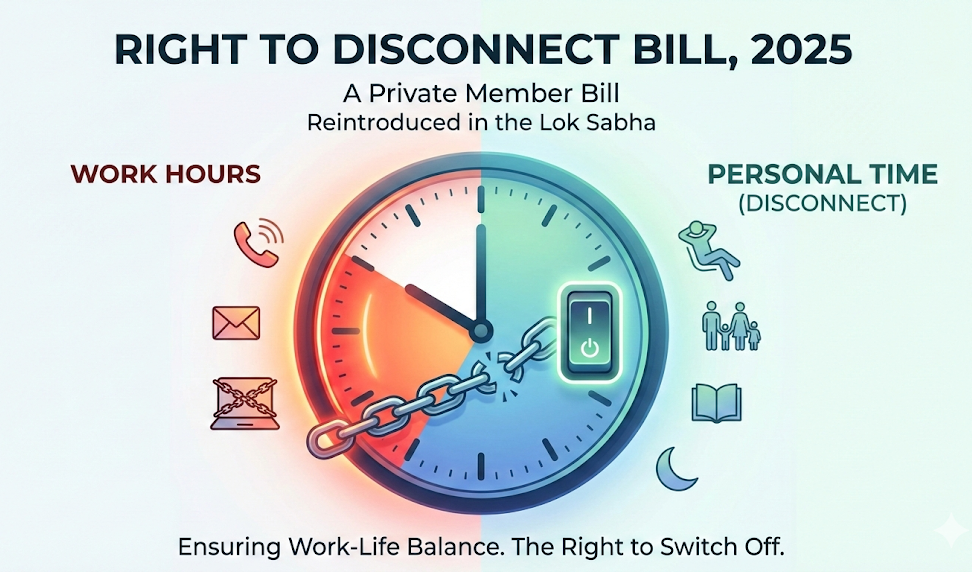
News : A private member bill “Right to Disconnect Bill, 2025”, reintroduced in the Lok Sabha.
In an era where the office follows you home in your pocket, the blurring line between professional and personal life has ignited a global conversation about a worker's fundamental right to log off. At its core, the 'Right to Disconnect' is a principle that protects an employee's time away from the job.
The Right to Disconnect refers to an employee’s right to not engage in work-related communications—such as calls, emails, or messages—outside official working hours.
The primary goal of this right is to shield workers from the pressures of constant digital connectivity, aiming to restore and protect a healthy work-life balance. This growing concern has led to concrete legislative proposals, such as the one recently introduced in India.
The 2025 'Right to Disconnect' Bill in India
A proposal titled the "Right to Disconnect Bill, 2025" has been reintroduced in the Lok Sabha as a private member bill, seeking to formalize these protections into law for Indian workers.
Key Protections and Mandates Proposed in the Bill
• Right to refuse after-hours communication: This gives employees the legal freedom to ignore work-related calls, emails, and messages after their shift ends without facing any disciplinary action.
• Establishment of an Employees’ Welfare Authority: This dedicated body would be responsible for implementing the rules and monitoring compliance, acting as a watchdog for employee rights.
• A national baseline study on digital communication burdens: This research would provide crucial data to understand the true scale of the digital burden placed on employees outside of work hours.
• Mandatory negotiations for companies with over 10 workers: This requires companies to formally agree with their employees on rules for after-hours work, ensuring that any such work qualifies for overtime pay.
• Creation of counselling services and digital detox centres: This provides direct support to help employees manage the mental and emotional stress associated with constant connectivity.
• Penalties for companies that violate the rules: This creates a significant financial incentive for companies to comply, with fines of up to 1% of their total employee remuneration.
Did You Know? Understanding a 'Private Member’s Bill'
• It is a legislative proposal introduced by a Member of Parliament (MP) who is not a government minister.
• Parliament typically debates these bills only on Fridays, and they are rarely enacted into law.
• Since India's Independence, only 14 private members’ bills have become law, with the last one passed in 1970.
While this bill charts a potential course for India, it is part of a much larger global conversation.
Global Adoption of This Right
The concept of a right to disconnect is not unique to India; it is part of a growing international movement to adapt labor laws to the digital age.
• About two dozen countries, primarily in Europe and Latin America, have already implemented similar regulations.
• France was a pioneer in this area, formally establishing a right to disconnect for its workers in 2017.
• Australia is one of the most recent adopters, enacting its own laws to protect workers' off-hours in 2024.
This international momentum raises the question of where India's current legal framework stands on the broader issue of worker welfare.
What is the Current Law in India?
Currently, India does not have a specific law that explicitly recognizes an employee's 'Right to Disconnect'. However, the Indian Constitution contains broader principles that direct the government to ensure the well-being of its workforce.
• Article 38 This article mandates that the state must strive to promote the welfare of the people.
• Article 39(e) This article is part of the Directive Principles of State Policy and directs the state to formulate its policy towards securing the health and strength of its workers.
Ultimately, the 'Right to Disconnect' is a modern response to a timeless challenge, seeking to ensure that in an always-on world, work enhances life rather than consumes it.
Click here to
Read More
Are you sure?
You want to delete this comment..!
Remove
Cancel