Grasslands of India
Climatic climax grasslands—where climate alone prevents forest growth—are nearly absent in the plains of India due to the dominant monsoon regime. Most Indian grasslands are seral in nature, representing an intermediate successional stage maintained by biotic and anthropogenic interventions. They are dynamically stabilized by a combination of seasonal droughts, periodic wildfire regimes, and systemic livestock grazing.
Champion and Seth Classification
Under the standard Champion and Seth forestry classification (1968), grasslands are categorized under Sub-Group 5B (Inland Riverine Pulse-savannahs), Group 10 (Subtropical Pine Forests with grass understorey), and Group 15 (Montane Wet Temperate Grasslands).
Dabadghao and Shankarnarayan Framework
The Indian Council of Agricultural Research (ICAR) recognizes five distinct structural grass-cover types across the country, based on dominant grass assemblages and agro-ecological zones:
- Sehima-Dichanthium Type: Spreads across the semi-arid Deccan Plateau, Central Indian highlands, and Chota Nagpur Plateau. The key grass species are Sehima nervosum and Dichanthium annulatum.
- Dichanthium-Cenchrus-Lasiurus Type: Confined to the arid and semi-arid tracts of Northwest India, including the Thar Desert, parts of Gujarat, and Rajasthan. It features highly drought-resistant species like Lasiurus scindicus (Sewa grass) and Cenchrus ciliaris (Anjan grass).
- Phragmites-Saccharum-Imperata Type: Found throughout the moist, low-lying, and waterlogged alluvial plains of the Indus-Ganga-Brahmaputra river basins and the Terai-Duar belt. Dominant species include Phragmites karka and Saccharum spontaneous (Wild sugarcane).
- Themeda-Arundinella Type: Covers the subtropical to humid montane tracts of the outer Himalayas, extending across Jammu & Kashmir, Himachal Pradesh, Uttarakhand, and the Northeast hills. The core vegetation consists of Themeda anathera and Arundinella nepalensis.
- Temperate-Alpine Type: Restricted to high-altitude zones above the timberline (>3,000 meters) in the inner Himalayan ranges. It features cold-hardy perennial turf grasses such as Poa, Festuca, and Agrostis.
Geographical Distribution and Typology
Semi-Arid and Savanna Grasslands of Central India and Deccan
These formations cover the extensive rain-shadow zones of the Western Ghats and the dry volcanic plains of Maharashtra, Madhya Pradesh, Karnataka, Andhra Pradesh, and Telangana. They are characterized by scattered Acacia and Butea monosperma (Flame of the Forest) trees interspaced with a continuous ground cover of perennial bunchgrasses.
Arid Grasslands of Northwest India
These specialized ecosystems occupy the dry sandy tracts of western Rajasthan and the salt-encrusted rangelands of Gujarat.
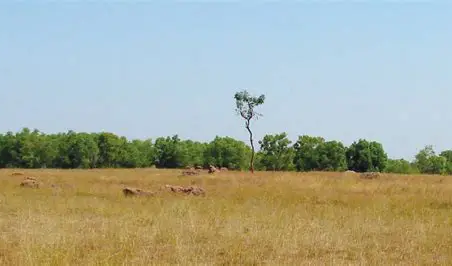
- Banni Grassland: Located in the southern edge of the Rann of Kutch, Gujarat, spanning over 2,500 square kilometers. It is one of Asia’s largest and finest contiguous tropical grasslands. It features salt-tolerant species like Dichanthium annulatum and Cenchrus ciliaris, which sustain the indigenous Maldhari pastoralist community and the elite Banni buffalo breed. Ekam IAS Academy
- Vidi Grasslands: Located in the Saurashtra region of Gujarat, these represent traditionally managed or state-protected grass reserves used primarily for fodder harvesting.
Terai-Duar Tall Grasslands
Stretching along the foothills of the Himalayas across Uttar Pradesh, Bihar, West Bengal, and Assam, these seasonal, flood-plain ecosystems are shaped by annual monsoon inundations from the Ganga and Brahmaputra river systems. They feature massive elephant grasses growing up to 4–6 meters high, creating the prime habitat for megaherbivores.
Montane and High-Altitude Grasslands
- Bugyals: High-altitude alpine meadows located in the Greater Himalayas, predominantly in Uttarakhand (e.g., Bedni Bugyal, Dayara Bugyal), lying between the tree line and the snow line (3,300 to 4,000 meters). They remain under snow cover during winter and erupt into vibrant perennial herb and grass carpets during summer, supporting transhumant pastoralists like the Bhotiyas and Gujjars. Vajiram & Ravi
- Marg: The regional nomenclature for high-altitude alpine meadows in Jammu & Kashmir (e.g., Gulmarg, Sonamarg).
- Shola Grasslands: High-altitude, rolling montane grasslands found in the Southern Western Ghats (Nilgiris, Anaimalai, and Palani hills) above 1,500 meters. They exist in a unique mosaic pattern with Shola forests (stunted evergreen patches nestled in frost-protected valleys). These grasslands are dominated by Chrysopogon zeylanicus and are highly vulnerable to frost and invasive woody exotics. Ekam IAS Academy
| Grassland Type / Name | Key State / UT | Altitudinal Range / Zone | Key Faunal Indicators |
|---|---|---|---|
| Banni Grasslands | Gujarat | Sea level to 50 m (Arid/Saline) | Cheetah (historical), Desert Cat, Indian Wolf |
| Terai Grasslands | Assam, UP, West Bengal | 100 m to 300 m (Floodplain) | One-horned Rhinoceros, Bengal Florican, Pygmy Hog |
| Bugyals / Margs | Uttarakhand, J&K | 3,000 m to 4,500 m (Alpine) | Snow Leopard, Himalayan Monal, Musk Deer |
| Shola Grasslands | Tamil Nadu, Kerala | 1,500 m to 2,600 m (Montane) | Nilgiri Tahr, Nilgiri Pipit, Laughingthrush |
| Velavadar Grassland | Gujarat | Flat Coastal Plain | Blackbuck (highest concentration), Lesser Florican |
Keystone Fauna and Ecological Interdependencies
Critically Endangered Avifauna
- Great Indian Bustard (Ardeotis nigriceps): The flagship species of India’s dry, open grasslands. It is an indicator of healthy semi-arid grassland ecosystems but faces imminent extinction due to habitat conversion and power-line collisions. The Prayas India
- Lesser Florican and Bengal Florican: Small bustard species completely dependent on dense, tall-grass covers for breeding and courtship displays.
- Jerdon’s Courser: A critically endangered, nocturnal cursorial bird restricted to the highly localized scrub and thin grassland patches of Andhra Pradesh (Sri Lankamalleswara Wildlife Sanctuary).
Mammalian Specializations
- Blackbuck (Antilope cervicapra): Endemic to the open plains of India, specializing in fast running to evade predators in treeless environments. The Prayas India
- Indian Wolf (Canis lupus pallipes): The apex predator of the semi-arid savanna landscapes, hunting in packs across open plains. The Prayas India
- Nilgiri Tahr (Nilgiritragus hylocrius): Mountain ungulate endemic to the steep, rocky cliffs adjoining the Shola grasslands of the Southern Western Ghats.
Threats and Constitutional/Policy Framework
Institutional and Classification Bottlenecks
A primary structural threat stems from the historical classification of grasslands as “Wastelands” in Revenue Department records and Wasteland Atlases of India. This misclassification facilitates the diversion of ecologically intact grassland ecosystems for solar parks, industrial hubs, and agricultural expansions. Additionally, forestry departments have historically implemented “Afforestation Drivers” inside natural grasslands, introducing woody canopies that disrupt the open ecosystem structure. Drishti IAS
Ecological Degradation and Invasive Species
- Prosopis juliflora: An exotic invasive shrub introduced to combat desertification in western India. It has completely overrun the Banni grasslands, altering soil chemistry and choking native palatable grass species.
- Lantana camara and Chromolaena odorata: These aggressive weeds have colonised the understorey of semi-arid and savanna grasslands, suppressing the regeneration of indigenous fodder grasses.
- Exotic Pine and Wattle Plantations: Historical commercial plantations of Eucalyptus, Pinus, and Acacia mearnsii (Wattle) within the Western Ghats have systematically converted natural Shola grasslands into monoculture timber patches.
Policy and Legal Protections
- National Forest Policy, 1988: Emphasizes managing forest-adjacent grasslands to meet the fodder requirements of rural and pastoral populations.
- Grazing and Livestock Policies: Managed via village common lands (Gauchar lands), legally protected under the jurisdiction of village Gram Sabhas. The Supreme Court of India in the landmark Jagpal Singh Case (2011) ruled against the illegal encroachment and commercial commercialization of village common lands and water bodies. ClearIAS
- Bonn Challenge Pledge: India has committed to restoring 26 million hectares of degraded land. This initiative increasingly targets the removal of invasive woody species from natural grasslands and the restoration of native perennial grass ecosystems.